---
title: "From Inspiration to Decision: Escaping the Pinterest Trap"
description: Pinterest is great for inspiration. It's a terrible place to finish. Here's why direction stalls and how real fabric digital twins fix it.
image: https://blog.twinbru.com/hubfs/Twinbru_Article_From%20Inspiration%20to%20Decision_Escaping%20the%20Pinterest%20Trap_Aug2026_Image01.jpg
---
- [Home](https://www.twinbru.com/)
- [3D Textures](https://www.twinbru.com/3d-textures)
- [Twinbru](https://textures.twinbru.com/)
- [NVIDIA Omniverse™](https://www.nvidia.com/en-us/omniverse/)
- [Kujiale/Coohom](https://www.kujiale.cn/pub/ddg/designer/shop/3FO4K54WQR06/home/new)
- [ArchiUp](https://archiup.com/en/brand/fibreguard)
- [Chaos®](https://cosmos.chaos.com/assets/creators/brands/twinbru-fabrics?q=eyJ0IjpbWzQ5OF0sWzc2M10sWzgxNV1dLCJjIjoxfQ)
- [Poliigon](https://www.poliigon.com/textures/fabric)
- [KeyShot](https://www.keyshot.com/resources/downloads/assets)
- [Architextures](https://architextures.org/)
- [Sketchfab](https://sketchfab.com/twinbru)
- [Emersya](https://emersya.com/en/home)
- [Zeel Project](https://zeelproject.com/textures/fabric/)
- [Mattoboard](https://mattoboard.com/)
- [Blenderkit](https://www.blenderkit.com/asset-gallery?query=order:-created+author_id:1283543)
- [Digital Services](https://www.twinbru.com/services)
- [Furniture brands](https://www.twinbru.com/services/furniture-brands)
- [Interior concepts](https://www.twinbru.com/services/interior-concepts)
- [Leisure industry](https://www.twinbru.com/services/leisure-industry)
- [Fabric distribution](https://www.twinbru.com/services/fabric-distribution)
- [Manufacturing](https://www.twinbru.com/services/manufacturing)
- [Render Engine](https://www.twinbru.com/engine)
- [API](https://www.twinbru.com/api)
- [Partnerships](https://www.twinbru.com/partnerships)
- [NVIDIA](https://www.twinbru.com/partnerships/nvidia)
- [Pantone X-Rite](https://www.twinbru.com/partnerships/x-rite)
- [Adobe Substance](https://www.twinbru.com/partnerships/substance)
- [Chaos®](https://www.twinbru.com/partnerships/chaos)
- [Vizoo](https://www.twinbru.com/partnerships/vizoo)
- [DMIx](https://www.twinbru.com/partnerships/dmix)
- [Glyph](https://www.twinbru.com/partnerships/glyph)
- [About](https://www.twinbru.com/about)
- [News](https://blog.twinbru.com)
- [Blog](https://blog.twinbru.com)
- [Vlogs](https://www.twinbru.com/vlogs)
- [Contact](https://www.twinbru.com/contact)
+32 3 451 8000
- [3D Textures](https://www.twinbru.com/3d-textures)
- [Digital Services](https://www.twinbru.com/services)
- [Render Engine](https://www.twinbru.com/engine)
- [API](https://www.twinbru.com/api)
- [Partnerships](https://www.twinbru.com/partnerships)
- [About](https://www.twinbru.com/about)
- [News](https://blog.twinbru.com)
- [Vlogs](https://www.twinbru.com/vlogs)
- [Contact](https://www.twinbru.com/contact)
# From Inspiration to Decision: Escaping the Pinterest Trap
Published by [Admin](https://blog.twinbru.com/author/admin) on Aug 4, 2026, 9:00:00 AM
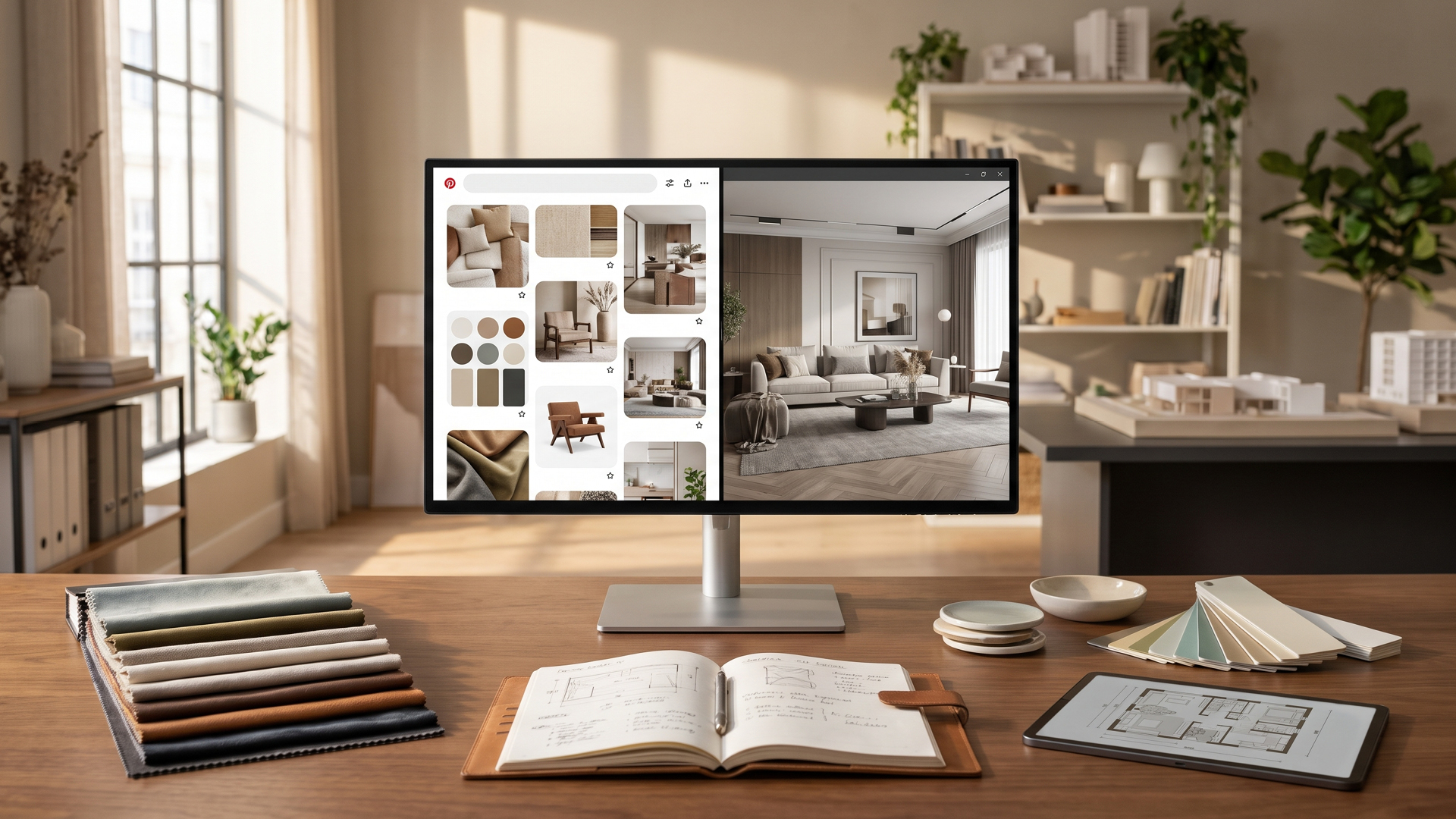
Every designer knows the meeting. You've spent hours curating references. The moodboard is considered, layered and full of intention. You walk in with forty images that collectively say something coherent and within ten minutes the room has scattered in five directions, everyone responding to a different image and nobody able to land on a choice.
The brief has not changed. The ideas are not wrong. But the meeting ends without a decision and you are back next week with another round.
> *This is not a creative problem. It is a presentation problem.*
## Why does a moodboard stall a meeting instead of helping to close one?
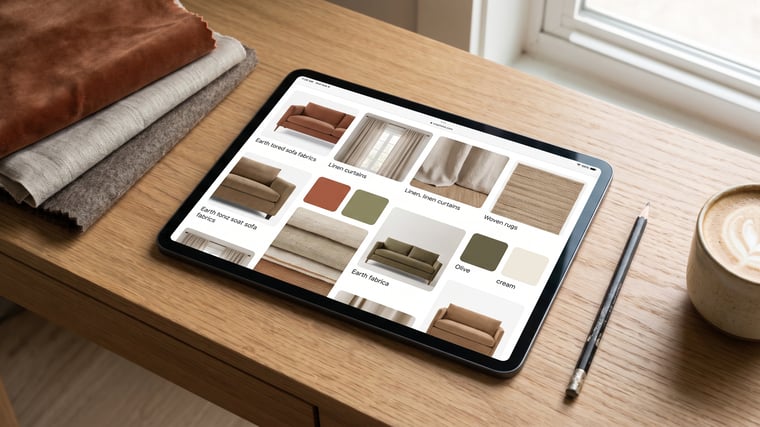
A moodboard is an invitation to react. It presents multiple stimuli simultaneously and asks people to feel something, which they do, immediately and differently. One person responds to the warm terracotta in the corner. Another is drawn to the linen texture in the centre. A third has already moved on to something they saw on a competitor's feed last week.
Moodboards are excellent at generating conversation. They are poor at closing one. The mistake is not using Pinterest. Pinterest does exactly what it is designed to do: surface visual inspiration at scale, find adjacencies you would not have found alone and give a project a visual vocabulary to start from. That is genuinely useful. The mistake is stopping there.
When inspiration lives only on a moodboard, it stays abstract. Stakeholders cannot feel how the velvet will present its pile across a sofa at scale. They cannot evaluate whether the warm neutral works with the floor tone in the actual scene. They are responding to fragments and fragmented input produces fragmented feedback.
## What does the approval loop actually cost?
Each inconclusive meeting has a price that rarely gets counted. There is the time in the room. There is the time for rebuilding the presentation. There is the slow erosion of confidence, in the project, in the direction and sometimes in the relationship.
And there is the deeper cost: the right idea gets delayed, not because it was wrong, but because it was never shown clearly enough to decide on.
Most revision cycles do not exist because the creative direction was off. They exist because the direction was shown in a way that left too much open to interpretation. The space between "inspired by" and "looks like this, in this room, with this material" is where decisions go to stall.

## Is a stalled approval a creative problem or a presentation problem?
It's almost always the presentation.
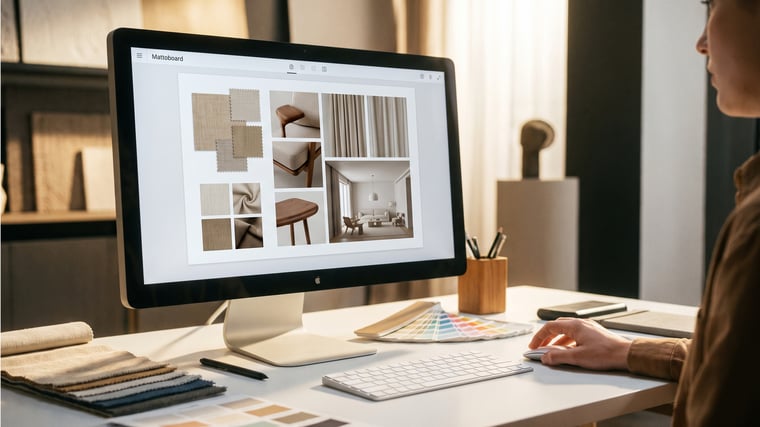
The shift that changes meeting behaviour is not finding a better reference. It is showing one direction, visible in its actual context, with real materials that can be evaluated. Not a collage of moods. One scene. The material on the piece. The colourway in the light. The texture at the scale it will actually live at.
When a stakeholder can see the direction rather than imagine it, the conversation changes. They stop reacting and start deciding. The question moves from "what does this feel like?" to yes or no, which is the only question that ends a meeting productively.
This is the step Pinterest cannot complete, and that is not a criticism of Pinterest. Inspiration and validation are different jobs. Collecting references is the divergent phase. Making a direction real enough to decide on is the convergent phase. Conflating the two is what creates the loop.
### **What is the new standard for material accuracy?**
There is a version of "showing in context" that does not solve the problem: the generic render. A direction presented with placeholder materials or approximated textures still leaves the room with doubt.
> *"Is that the actual fabric?"*
> *"How does it look under different light?"*
> *"Will it match what we are ordering?"*
The questions are slightly different, but the effect is the same: the decision does not stick.
Accuracy matters not just aesthetically but psychologically. When stakeholders know they are looking at the real material, the comparison becomes real. The doubt that usually delays a decision, the nagging sense that the render will not match what arrives, is removed. What they approve is what they will get.
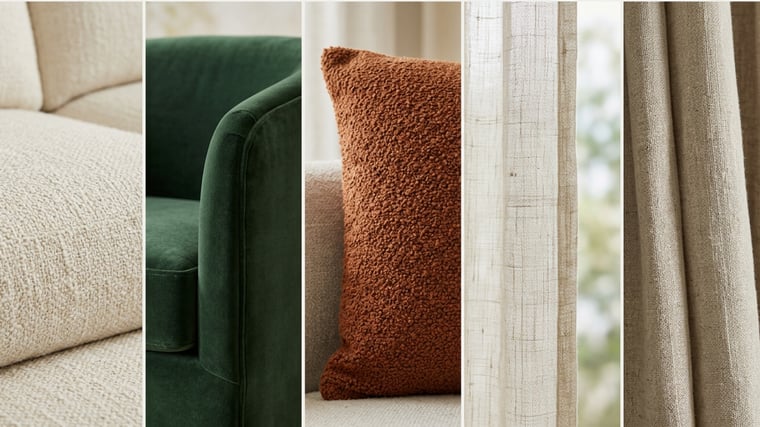
This is what digital twins of real fabrics do that a generic texture library cannot. The fabrics from Twinbru are scanned replicas of physical fabrics; materials that exist, that can be ordered, and that will behave in a render the way they behave in a room. When you place them in a scene, you are not approximating. You are validating.
The workflow follows naturally from how designers already work: use Pinterest to find the direction and use Twinbru to make it real. Pull the fabric from the library, apply it to the model and show the scene in context. The inspiration that started on a board becomes something the room can actually decide on.
### 
## The skill is not inspiration. It is enabling decisions.
Everyone in the room can be inspired. The skill that shortens projects, reduces rounds and builds client confidence is knowing how to make one direction so visible and so real that the room has no choice but to decide. Pinterest gets you to the idea. Twinbru gets you to the answer.
[Explore Twinbru Textures](https://textures.twinbru.com/)
---
### **In summary**
- Moodboards invite reaction, not resolution, that is by design. Use them for what they are
good at.
- The approval loop exists because inspiration was never translated into something
decision-ready.
- Showing one direction in context with real materials changes how a room behaves.
- Generic renders leave room for doubt. Real fabric digital twins remove it.
- Use Pinterest to inspire. Use Twinbru to validate.
[Explore Twinbru Textures](https://textures.twinbru.com/)
Tags: [3D Visualisation](https://blog.twinbru.com/tag/3d-visualisation), [3D Modeling](https://blog.twinbru.com/tag/3d-modeling), [Digital Textures](https://blog.twinbru.com/tag/digital-textures), [3D Textures](https://blog.twinbru.com/tag/3d-textures), [3D Fabric Textures](https://blog.twinbru.com/tag/3d-fabric-textures), [3D Upholstery Fabric](https://blog.twinbru.com/tag/3d-upholstery-fabric), [Digital Fabrics](https://blog.twinbru.com/tag/digital-fabrics)
[Back to Blog](https://blog.twinbru.com)
### If you liked our content, feel free to share!
## Related Articles
## [Digital twins decoded: From X-Rite scan to shippable fabric](https://blog.twinbru.com/digital-twins-decoded-from-x-rite-scan-to-shippable-fabric)
The furniture industry has a fundamental problem: the gap between what designers visualise and what...
[Read More](https://blog.twinbru.com/digital-twins-decoded-from-x-rite-scan-to-shippable-fabric)
## [The new craft: Where human taste meets digital proof](https://blog.twinbru.com/the-new-craft-where-human-taste-meets-digital-proof)
Perfect rendering has always meant knowing your materials. The way light falls on linen. The way...
[Read More](https://blog.twinbru.com/the-new-craft-where-human-taste-meets-digital-proof)
## [Rendering at the speed of thought: Real-time takes the lead](https://blog.twinbru.com/rendering-at-the-speed-of-thought-real-time-takes-the-leadng-the-way-fabrics-are-designed-specified-and-delivered-clone)
There's a generational divide in architectural visualisation. Older professionals remember the...
[Read More](https://blog.twinbru.com/rendering-at-the-speed-of-thought-real-time-takes-the-leadng-the-way-fabrics-are-designed-specified-and-delivered-clone)
[](https://twinbru.com/)
- Company
- Built by Bru
- About
- News
- Contact
- Vacancies
- Pages
- Platforms
- Partnerships
- Use Cases
- Legal
- Terms & Conditions
- Privacy Statement
- Disclaimer
- Cookies
- Manage Privacy Settings
Follow us
Copyright © 2023 Bru. All rights reserved
[+32 3 451 8000](tel:+32%203%20451%208000)
Head office: Bru Textiles nv, Satenrozen 2A, B-2550 Kontich, Belgium
```json
{
"@context" : "https://schema.org",
"@type" : "BlogPosting",
"author" : {
"@type" : "Person",
"name" : "Admin",
"url" : "https://blog.twinbru.com/author/admin"
},
"dateModified" : "2026-08-04T07:00:00.192Z",
"datePublished" : "2026-08-04T07:00:00.000Z",
"headline" : "From Inspiration to Decision: Escaping the Pinterest Trap",
"image" : [ "https://blog.twinbru.com/hubfs/Twinbru_Article_From%20Inspiration%20to%20Decision_Escaping%20the%20Pinterest%20Trap_Aug2026_Image01.jpg" ],
"mainEntityOfPage" : {
"@id" : "https://blog.twinbru.com/from-inspiration-to-decision-escaping-the-pinterest-trap",
"@type" : "WebPage"
},
"publisher" : {
"@type" : "Organization",
"logo" : {
"@type" : "ImageObject",
"url" : "https://blog.twinbru.com/hubfs/twinbru_logo_RGB.png"
},
"name" : "Bru Textiles NV"
}
}
```