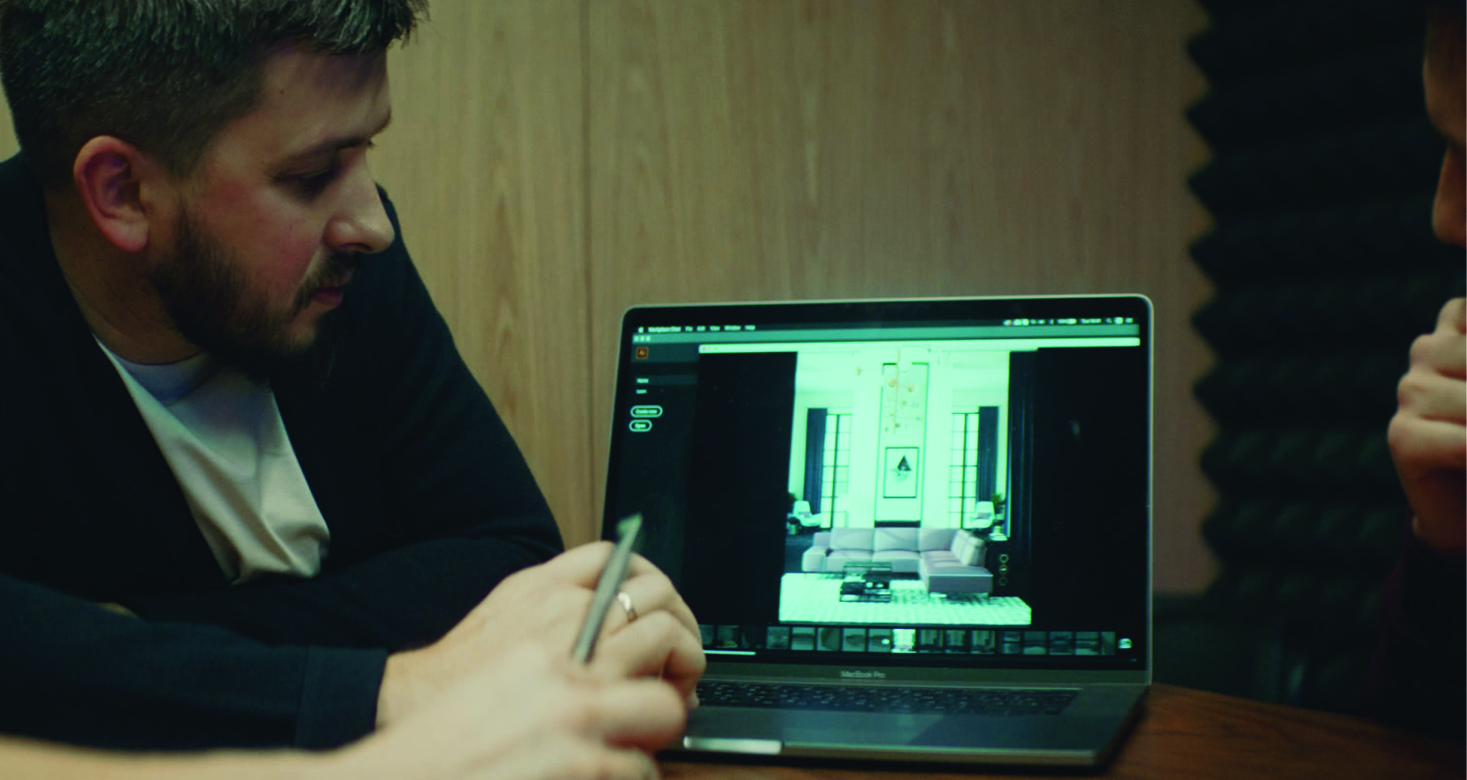
Perfect rendering has always meant knowing your materials. The way light falls on linen. The way velvet absorbs shadow instead of reflecting it. The weight a curtain holds when it drapes versus when it billows. That knowledge used to be the whole craft.
It still is. But it now requires something else as well.
The new version of knowing your materials is knowing when your digital material is telling the truth.
Recognising artificial-looking fabric
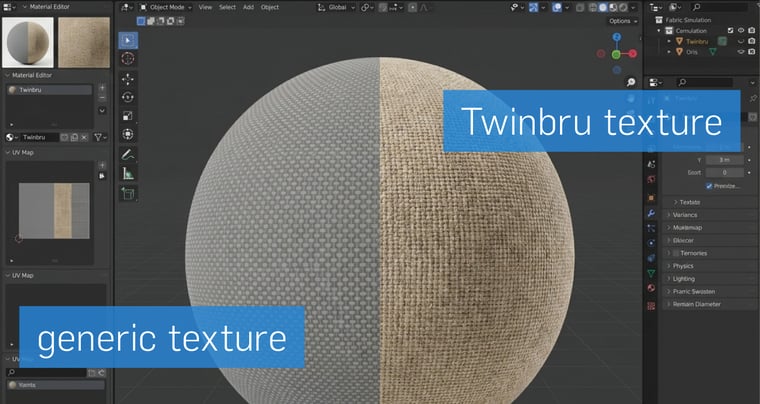
There is a reason experienced clients and stakeholders get a nagging sense that something is not right even when they cannot articulate it. The human eye is remarkably good at detecting surfaces that do not behave the way real materials do. Flat weave. Repeating pattern. No surface depth. No response to light.
Generic fabric textures fail these tests consistently and they fail them in exactly the moments that matter most: the final presentation, the approval meeting and the decision that either moves a project forward or sends it back for another round.
The cost is not just aesthetic. Every revision round triggered by a material that did not convince a stakeholder is a visibility failure with a price attached.
Is taste enough to make a render trustworthy?
A strong creative eye sets direction. It chooses warmth over cool, texture over flatness, one fabric over another because it serves the story of the room. That instinct matters and it cannot be replaced.
But taste cannot verify itself. A confident choice and a correct one look identical in a render until someone questions whether the material is real. At that point taste needs proof to become a professional position rather than a preference that happens to look good.
Generic textures undermine this. They are built for visual plausibility, not physical accuracy. The weave is approximated. The surface depth is constructed. The light response is consistent because it has been designed to look consistent, not because the material actually behaves that way.
The moment a client leans in or holds a swatch next to the screen, the gap is visible. And once visible, it is impossible to unsee.
A real fabric digital twin removes that vulnerability. It is a scanned replica of a physical fabric, traceable back to a material that exists in the physical world and can be ordered.
When a render is built on a digital twin, the work carries its own evidence. The designer doesn't need to convince anyone. The material already is what it claims to be.

The factors that make the difference
Three qualities separate a real fabric digital twin from a generic texture in practice:
Lighting consistency. A Twinbru digital fabric responds to light the way a physical fabric does. Warm light, cool light, directional light, ambient light, the material reads correctly across all of them. Generic textures often look convincing under one lighting setup and fall apart under another, which is exactly when client doubt appears.
Scale and weave accuracy. The weave structure of a real fabric has a scale relationship to the objects it covers. A sofa upholstered in a fabric with a visible weave looks different at arm's length than in a hero wide shot. Twinbru digital twins carry this scale accuracy because they are scanned from the physical material, not drawn or generated to approximate it.
Drape and surface response. Real fabric has a surface character that changes with angle and tension. The way a curtain folds, the way an upholstered armrest catches light at its edge, the subtle compression of a cushion fabric, these are qualities that generic textures cannot replicate consistently. A Twinbru digital twin captures these surface behaviours because the source material has them.
This has a direct professional consequence. When the material in a render is honest, stakeholder confidence increases, approval rounds decrease and the decisions built on top of that render hold up under scrutiny at every stage.

Twinbru Textures: the library built on real fabric
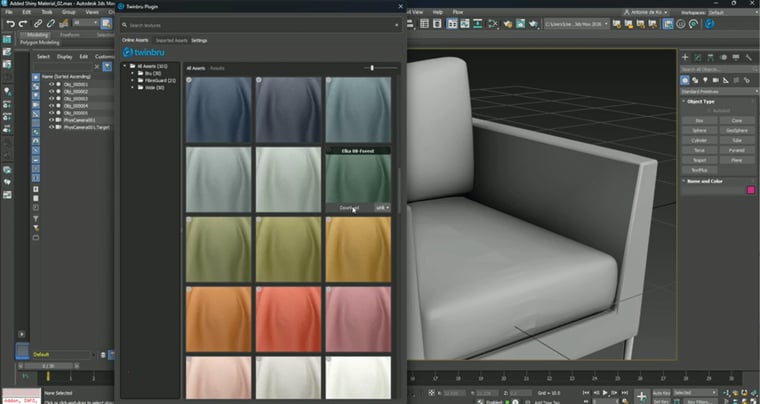
The Twinbru Textures library is where these standards are made accessible. Every material in the library is a scanned digital twin of a real fabric, available to apply directly into a 3D scene and available to order in the physical world.
Designers working from the library are not choosing from a catalogue of approximations. They are choosing from a catalogue of real materials, which is a fundamentally different starting point for any render. The library is built for designers who need accuracy at speed, real fabrics ready to apply across formats and render environments without the need to build or approximate materials from scratch.
FibreGuard Plugin: accuracy inside the workflow
The FibreGuard Plugin brings the Twinbru Textures standard directly into the 3D workflow. Real fabrics, applied in context, iterated fast. The plugin removes the friction between finding a material and using it, so designers can swap, compare and present real fabric options without leaving their render environment.
The result is a workflow where material accuracy is not an extra step but a built-in condition. Every render produced through the plugin starts with a real fabric, which means every render produced through the plugin is already more trustworthy than one built on a generic texture library.
What changes when the material is honest
When the material in a render is real, something changes in the room where the decision is being made. Stakeholders stop questioning and start confirming. The doubt that usually delays a decision disappears because there is nothing to doubt. What they are looking at is what they are getting.
The benefit is not just a better-looking render. It is a shorter approval cycle, a more confident client and a chain of decisions that holds up under scrutiny because it was built on honest materials from the start.
Consistency across scene types, lighting conditions and presentation formats follows naturally from this foundation. A real fabric digital twin does not need to be re-optimised for each environment because its accuracy is structural, not situational.
The craft hasn't changed. What it requires has.
The standard of professional 3D visualisation has always been knowing your materials. What has changed is what that knowledge now requires.
A generic texture that looks convincing is not the same as a material that is honest. The difference shows up in approval meetings, in client doubt, in revision rounds that could have been avoided and in the gap between what was shown and what was delivered.
Real fabric digital twins close that gap. The Twinbru Textures library and the FibreGuard Plugin exist to make that standard practical, fast and accessible inside the workflows designers already use.
The question isn't whether to use real fabric digital twins. The tools exist. The standard is clear. The question is whether the workflow demands their use and whether the work that leaves your hands can carry its own argument without you standing next to it explaining why it is right.
Download the FibreGuard Plugin
TL;DR
- Knowing your materials has always defined good rendering. Knowing if your digital material is truthful is the new requirement.
- Taste sets direction but cannot verify itself. It needs proof to become defensible.
- A genuine digital twin makes the work speak for itself without the renderer needing to convince anyone.
- Generic textures put the entire decision chain at risk the moment they fail under real scrutiny.
- Real-material accuracy separates trusted professionals from beautiful guesses.
- Twinbru Textures and the FibreGuard Plugin exist to make that standard practical, fast and reliable.